Beta
This website is in development — content and design are still changing
Model
AIM-Hub AIM
The Asia-Pacific Integrated Model (AIM) is a large-scale computer simulation model developed by the National Institute for Environmental Studies in collaboration with Kyoto University, Mizuho Information & Research Institute and several research institutes in the Asia-Pacific region. The AIM assesses policy options for stabilizing the global climate, particularly in the
The Asia-Pacific Integrated Model (AIM) is a large-scale computer simulation model developed by the National Institute for Environmental Studies in collaboration with Kyoto University, Mizuho Information & Research Institute and several research institutes in the Asia-Pacific region. The AIM assesses policy options for stabilizing the global climate, particularly in the Asia-Pacific region, with the objectives of reducing greenhouse gas emissions and avoiding the impacts of climate change.
The Asia-Pacific Integrated Modeling/Computable General Equilibrium (AIM/CGE) model was developed to analyze the climate change mitigation and its impact. To meet this objective, the energy system is disaggregated into energy supply and demand sides. Agricultural sectors are also disaggregated for appropriate land-use treatment. The model is designed to have the flexibility to be used at a global and individual country scale.
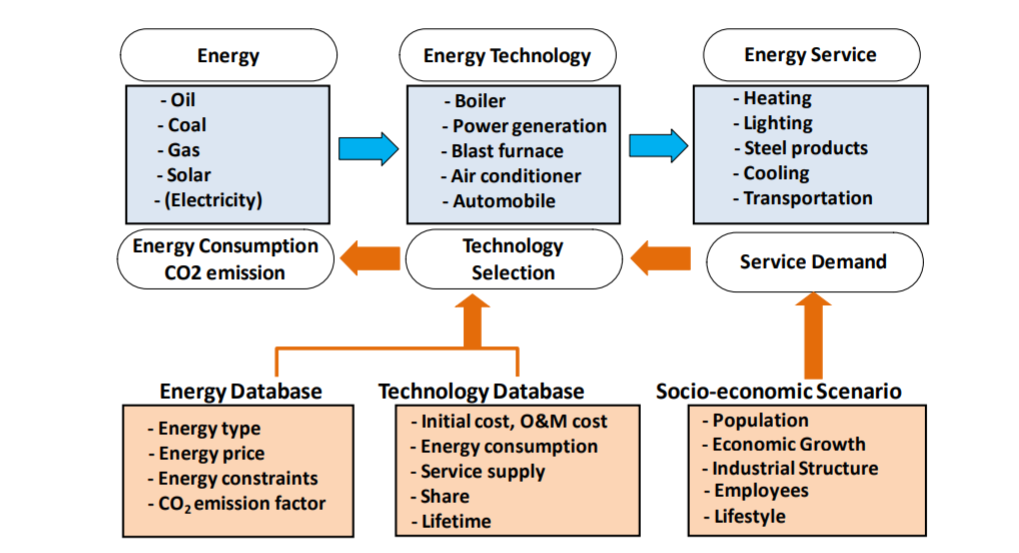
The AIM/end-use model first estimates energy service demands based on socio-economic factors such as population, economic growth, industrial structure, and lifestyle, and then calculates what kind of technology will be used to what extent. To compare and consider energy technologies, detailed technological data and energy data are prepared. Once the kind of energy technology to be used is known, the model calculates the energy necessary to provide the energy services and the amount of CO2 emissions produced when each type of energy technology operates.
On April 12, 2026, the Center for Global Sustainability at the University of Maryland, Peking University and Tsinghua University celebrated the release of GCAM-China-v8. This update introduces a series of new features, including harmonization with the latest global GCAM v8.2 framework, updating the base year to 2021, introducing a provincial-level
We are pleased to share several recent developments and resources that may be of interest to the community: Preprint on New SSP OperationalizationA preprint article has been released introducing a new operationalization of the Shared Socioeconomic Pathways (SSPs) for 188 countries through 2150. This work covers a wide range of
Bc3 is pleased to announce the release of the first version of GCAM-Europe, an expansion of the well-established GCAM model. The model is fully accessible via our GitHub repository: https://github.com/bc3LC-GCAMEurope