Beta
This website is in development — content and design are still changing
Model
C3IAM – China’s Climate Change Integrated Assessment Model INDC
A series of global actions have been made to address climate change. As a recent developed climate policy, Intended Nationally Determined Contributions (INDC) have renewed attention to the importance of exploring temperature rise levels lower than 2 °C, in particular a long-term limit of 1.5 °C, compared to the preindustrial
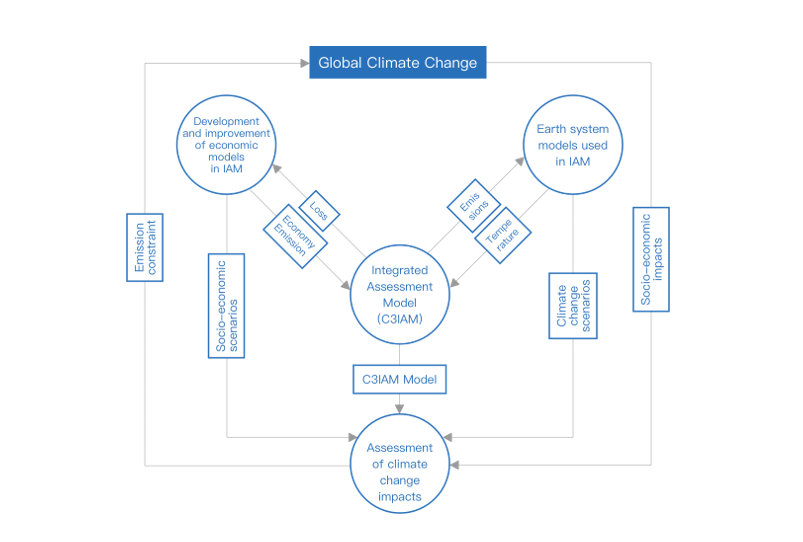
A series of global actions have been made to address climate change. As a recent developed climate policy, Intended Nationally Determined Contributions (INDC) have renewed attention to the importance of exploring temperature rise levels lower than 2 °C, in particular a long-term limit of 1.5 °C, compared to the preindustrial level. Nonetheless, achieving the 2 °C target under the current INDCs depends on dynamic socioeconomic development pathways. Therefore, this study conducts an integrated assessment of INDCs by taking into account different Shared Socioeconomic Pathways (SSPs). To that end, the CEEP-BIT research community develops the China’s Climate Change Integrated Assessment Model (C3IAM) to assess the climate change under SSPs in the context of with and without INDCs. Three SSPs, including “a green growth strategy” (SSP1), “a more middle-of-the-road development pattern” (SSP2) and “further fragmentation between regions” (SSP3) form the focus of this study. Results show that after considering INDCs, mitigation costs become very low and they have no evident positive changes in three SSPs. In 2100, a temperature rise would occur in SSP1-3, which is 3.20, 3.48 and 3.59 °C, respectively. There are long-term difficulties to keep warming well below 2 °C and pursue efforts toward 1.5 °C target even under INDCs. A drastic reduction in greenhouse gas emissions is needed in order to mitigate potentially catastrophic climate change impacts. This work contributes on realizing the hard link between the earth and socioeconomic systems, as well as extending the economic models by coupling the global CGE model with the economic optimum growth model. In C3IAM, China’s energy consumption and emissions pattern are investigated and refined. This study can provide policy makers and the public a better understanding about pathways through which different scenarios could unfold toward 2100, highlights the real mitigation and adaption challenges faced by climate change and can lead to formulating effective policies.
On April 12, 2026, the Center for Global Sustainability at the University of Maryland, Peking University and Tsinghua University celebrated the release of GCAM-China-v8. This update introduces a series of new features, including harmonization with the latest global GCAM v8.2 framework, updating the base year to 2021, introducing a provincial-level
We are pleased to share several recent developments and resources that may be of interest to the community: Preprint on New SSP OperationalizationA preprint article has been released introducing a new operationalization of the Shared Socioeconomic Pathways (SSPs) for 188 countries through 2150. This work covers a wide range of
Bc3 is pleased to announce the release of the first version of GCAM-Europe, an expansion of the well-established GCAM model. The model is fully accessible via our GitHub repository: https://github.com/bc3LC-GCAMEurope