Beta
This website is in development — content and design are still changing
Model
ENV-Linkages Model OECD
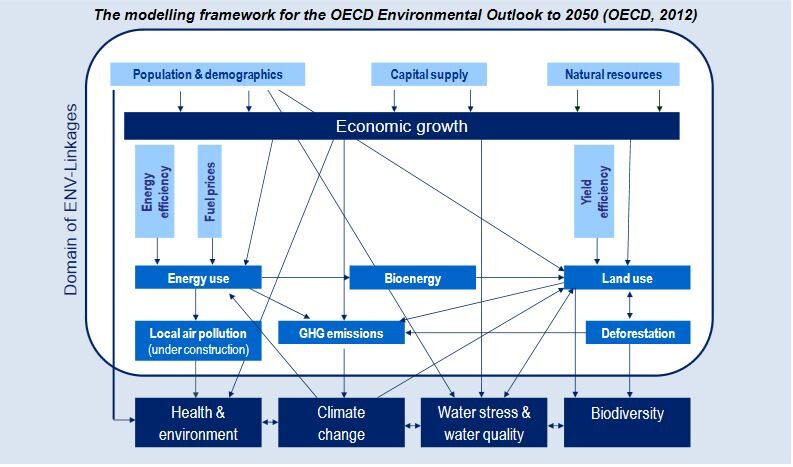
Developer or Source: Organisation for Economic Co-operation and Development (OECD) The ENV-Linkages Computable General Equilibrium (CGE) model is an economic model that describes how economic activities are inter-linked across several macroeconomic sectors and regions. It links economic activity to environmental pressure, specifically to emissions of greenhouse gases (GHGs). The links
The ENV-Linkages Computable General Equilibrium (CGE) model is an economic model that describes how economic activities are inter-linked across several macroeconomic sectors and regions. It links economic activity to environmental pressure, specifically to emissions of greenhouse gases (GHGs). The links between economic activities and emissions are projected for several decades into the future, and thus shed light on the impacts of environmental policies for the medium- and long-term future. The modelling work based on ENV-Linkages aims to assist governments in identifying least-cost policies or policy mixes on a range of environmental issues, including mitigation of climate change, phasing out fossil fuel subsidies and other green growth policies, such as environmental tax reform.
On April 12, 2026, the Center for Global Sustainability at the University of Maryland, Peking University and Tsinghua University celebrated the release of GCAM-China-v8. This update introduces a series of new features, including harmonization with the latest global GCAM v8.2 framework, updating the base year to 2021, introducing a provincial-level
We are pleased to share several recent developments and resources that may be of interest to the community: Preprint on New SSP OperationalizationA preprint article has been released introducing a new operationalization of the Shared Socioeconomic Pathways (SSPs) for 188 countries through 2150. This work covers a wide range of
Bc3 is pleased to announce the release of the first version of GCAM-Europe, an expansion of the well-established GCAM model. The model is fully accessible via our GitHub repository: https://github.com/bc3LC-GCAMEurope