Beta This website is in development — content and design are still changing
IAMC

Model

EXIOMOD 2.0 – EXtended Input-Output MODel

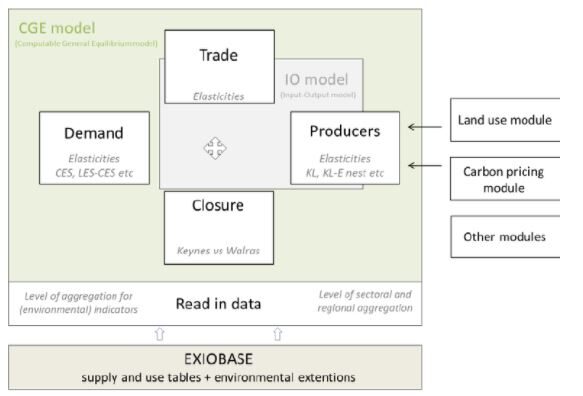
EXIOMOD is an economic model able to measure the environmental impact of economic activities. As a multisector model, it accounts for the economic dependency between sectors. It is also a global and multi-country model with a consistent trade linking between countries at the commodity level. Based on national account data,

EXIOMOD is an economic model able to measure the environmental impact of economic activities. As a multisector model, it accounts for the economic dependency between sectors. It is also a global and multi-country model with a consistent trade linking between countries at the commodity level. Based on national account data, it can provide compressive scenarios regarding the evolution of key economic variables such as GDP, value-added, turn-over, (intermediary and final) consumption, investment, employment, trade (exports and imports), public spending or taxes. Thanks to its environmental extensions, it makes the link between the economic activities of various agents (sectors, consumers) and the use of a large number of resources (energy, mineral, biomass, land, water) and negative externalities (greenhouse gases, wastes)

More models

Celebrating the Release of GCAM-China-v8 to Support China’s National Climate Assessment

On April 12, 2026, the Center for Global Sustainability at the University of Maryland, Peking University and Tsinghua University celebrated the release of GCAM-China-v8. This update introduces a series of new features, including harmonization with the latest global GCAM v8.2 framework, updating the base year to 2021, introducing a provincial-level

IFs Model: Updates and Resources SSPs

We are pleased to share several recent developments and resources that may be of interest to the community: Preprint on New SSP OperationalizationA preprint article has been released introducing a new operationalization of the Shared Socioeconomic Pathways (SSPs) for 188 countries through 2150. This work covers a wide range of