Beta
This website is in development — content and design are still changing
Model
FASOM-GHG – Forestry and Agricultural Sector Optimization Model with Greenhouse Gases FASOM-GHG
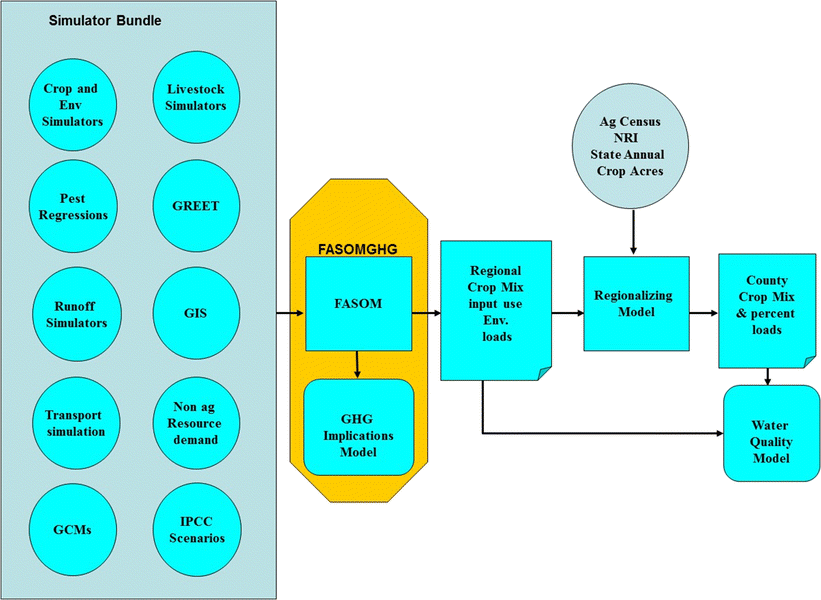
FASOM-GHG is a dynamic, multi-period, intertemporal, price-endogenous, mathematical programming model depicting land transfers and other resource allocations between and within the agricultural and forest sectors in the US. The model solution portrays simultaneous market equilibrium over an extended time, typically 40 to 100 years on a five year time step
FASOM-GHG is a dynamic, multi-period, intertemporal, price-endogenous, mathematical programming model depicting land transfers and other resource allocations between and within the agricultural and forest sectors in the US. The model solution portrays simultaneous market equilibrium over an extended time, typically 40 to 100 years on a five year time step basis. The results from FASOM-GHG yield a dynamic simulation of prices, production, management, consumption, GHG effects, and other environmental and economic indicators within these two sectors, under the chosen policy scenario. The model simulates the potential allocation of land over time to competing activities in both the forest and agricultural sectors. In doing this it simulates the potential consequences of different modeled policies for the commodity markets supplied by these lands and the net greenhouse gas (GHG) emissions. The model was developed to evaluate the welfare and market impacts of public policies and environmental changes affecting agriculture and forestry. To date, FASOM-GHG and its predecessor models FASOM and ASM have been used to examine the effects of GHG mitigation policy, climate change impacts, public timber harvest policy, federal farm program policy, bioenergy prospects, and pulpwood production by agriculture among other policies and environmental changes.
On April 12, 2026, the Center for Global Sustainability at the University of Maryland, Peking University and Tsinghua University celebrated the release of GCAM-China-v8. This update introduces a series of new features, including harmonization with the latest global GCAM v8.2 framework, updating the base year to 2021, introducing a provincial-level
We are pleased to share several recent developments and resources that may be of interest to the community: Preprint on New SSP OperationalizationA preprint article has been released introducing a new operationalization of the Shared Socioeconomic Pathways (SSPs) for 188 countries through 2150. This work covers a wide range of
Bc3 is pleased to announce the release of the first version of GCAM-Europe, an expansion of the well-established GCAM model. The model is fully accessible via our GitHub repository: https://github.com/bc3LC-GCAMEurope