Beta
This website is in development — content and design are still changing
Model
GCAM
GCAM is an integrated, multi-sector model that explores both human and Earth system dynamics. The role of models like GCAM is to bring multiple human and physical Earth systems together in one place to shed light on system interactions and provide scientific insights that would not otherwise be available from
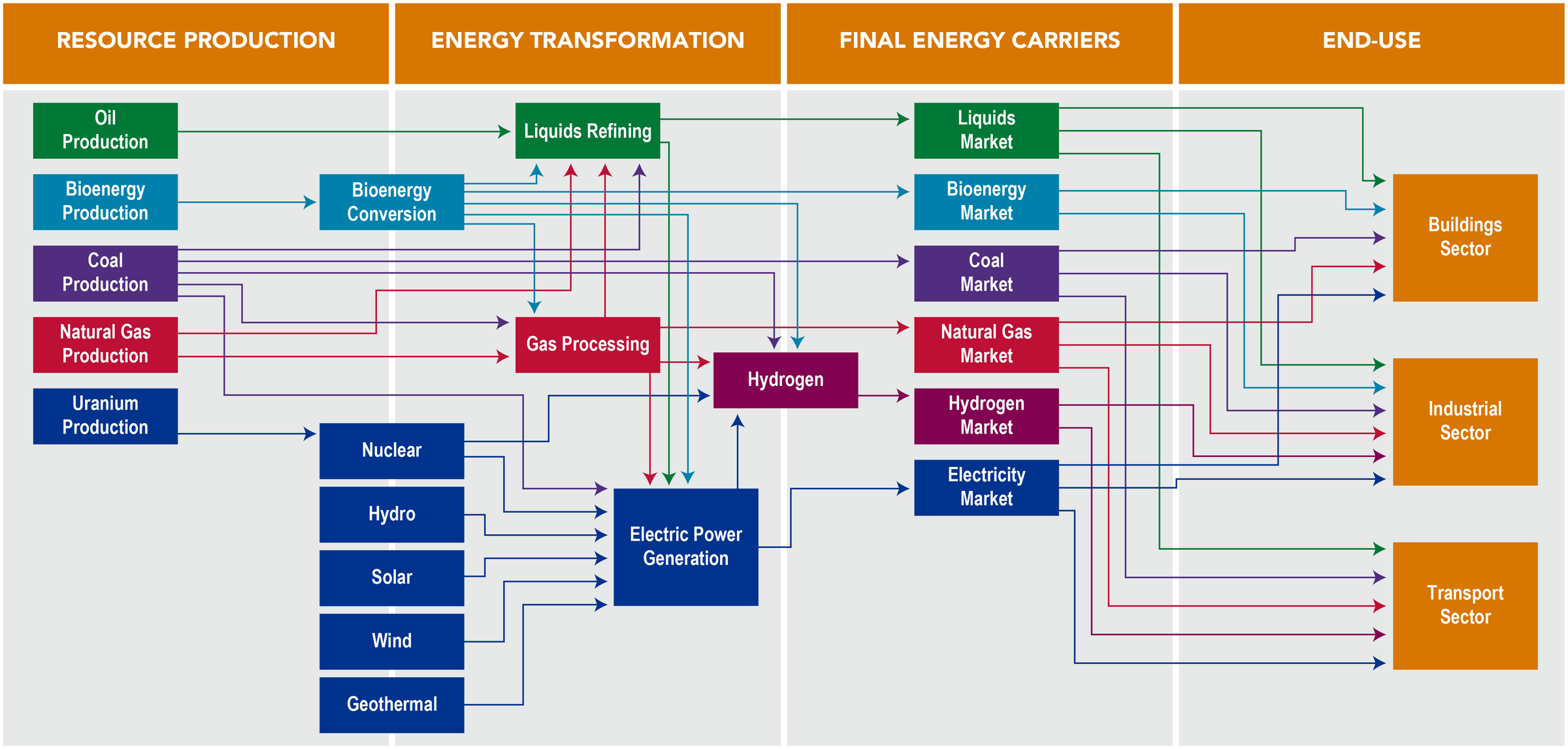
GCAM is an integrated, multi-sector model that explores both human and Earth system dynamics. The role of models like GCAM is to bring multiple human and physical Earth systems together in one place to shed light on system interactions and provide scientific insights that would not otherwise be available from the pursuit of traditional disciplinary scientific research alone. GCAM is constructed to explore these interactions in a single computational platform with a sufficiently low computational requirement to allow for broad explorations of scenarios and uncertainties. Components of GCAM are designed to capture the behavior of human and physical systems, but they do not necessarily include the most detailed process-scale representations of its constituent components. On the other hand, model components in principle provide a faithful representation of the best current scientific understanding of underlying behavior.
GCAM is a dynamic recursive model, meaning that decision-makers do not know the future when making a decision today. After it solves each period, the model then uses the resulting state of the world, including the consequences of decisions made in that period – such as resource depletion, capital stock retirements and installations, and changes to the landscape – and then moves to the next time step and performs the same exercise. For long-lived investments, decision-makers may account for future profit streams, but those estimates would be based on current prices. For some parts of the model, economic agents use prior experience to form expectations based on multi-period experiences.
On April 12, 2026, the Center for Global Sustainability at the University of Maryland, Peking University and Tsinghua University celebrated the release of GCAM-China-v8. This update introduces a series of new features, including harmonization with the latest global GCAM v8.2 framework, updating the base year to 2021, introducing a provincial-level
We are pleased to share several recent developments and resources that may be of interest to the community: Preprint on New SSP OperationalizationA preprint article has been released introducing a new operationalization of the Shared Socioeconomic Pathways (SSPs) for 188 countries through 2150. This work covers a wide range of
Bc3 is pleased to announce the release of the first version of GCAM-Europe, an expansion of the well-established GCAM model. The model is fully accessible via our GitHub repository: https://github.com/bc3LC-GCAMEurope