Beta
This website is in development — content and design are still changing
Model
GEM-E3
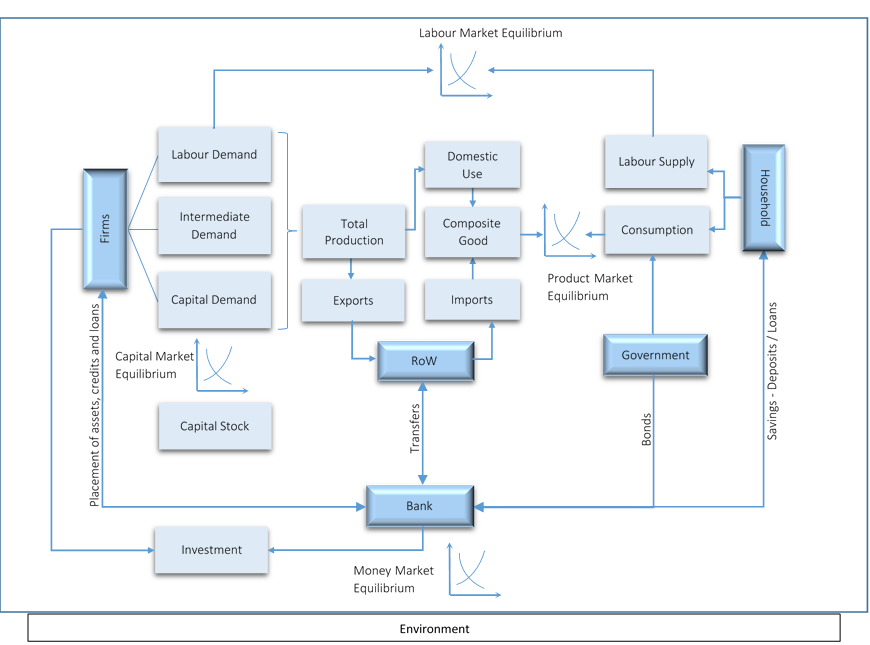
The General Equilibrium Model for Economy-Energy-Environment (GEM-E3) is a multi-regional, multi-sectoral, recursive dynamic computable general equilibrium (CGE) model which provides details on the macro-economy and its interaction with the environment and the energy system. It is an empirical, large scale model written entirely in structural form. It is well suited
The General Equilibrium Model for Economy-Energy-Environment (GEM-E3) is a multi-regional, multi-sectoral, recursive dynamic computable general equilibrium (CGE) model which provides details on the macro-economy and its interaction with the environment and the energy system. It is an empirical, large scale model written entirely in structural form. It is well suited to evaluate climate and energy policies, as well as fiscal issues.
GEM-E3 incorporates micro-economic mechanisms and institutional features within a consistent macro-economic framework and avoids the representation of behaviour in reduced form. The GEM-E3 model includes projections of: full Input-Output tables by country/region, national accounts, employment, balance of payments, public finance and revenues, household consumption, energy use and supply, GHG emissions and atmospheric pollutants.
The model features perfect competition market regimes, discrete representation of power producing technologies, semi-endogenous learning by doing effects, equilibrium unemployment, option to introduce energy efficiency standards, formulates emission permits for GHG and atmospheric pollutants. The environmental module includes flexibility instruments allowing for a variety of options when simulating emission abatement policies, including: different allocation schemes (grandfathering, auctioning, etc.), user-defined bubbles for traders, various systems of exemptions, various systems for revenue recycling, etc.
The GEM-E3 model has been used for several Directorates General of the European Commission, as well as for national authorities. The GEM-E3 modelling groups are also partner in several research projects, and analyses based on GEM-E3 have been published widely.
On April 12, 2026, the Center for Global Sustainability at the University of Maryland, Peking University and Tsinghua University celebrated the release of GCAM-China-v8. This update introduces a series of new features, including harmonization with the latest global GCAM v8.2 framework, updating the base year to 2021, introducing a provincial-level
We are pleased to share several recent developments and resources that may be of interest to the community: Preprint on New SSP OperationalizationA preprint article has been released introducing a new operationalization of the Shared Socioeconomic Pathways (SSPs) for 188 countries through 2150. This work covers a wide range of
Bc3 is pleased to announce the release of the first version of GCAM-Europe, an expansion of the well-established GCAM model. The model is fully accessible via our GitHub repository: https://github.com/bc3LC-GCAMEurope