Beta
This website is in development — content and design are still changing
Model
ICES CGE
ICES is a recursive dynamic multiregional Computable General Equilibrium (CGE) model to assess impacts of climate change on the economic system and to study mitigation and adaptation policies. ICES is a multipurpose tool to assess impacts of climate change on the economic system, evaluate costs of mitigation and adaptation policies, describe the key role of public
ICES is a recursive dynamic multiregional Computable General Equilibrium (CGE) model to assess impacts of climate change on the economic system and to study mitigation and adaptation policies.
ICES is a multipurpose tool to assess impacts of climate change on the economic system, evaluate costs of mitigation and adaptation policies, describe the key role of public sector for mitigation and adaptation policies, and draw future sustainability scenarios.
The model’s general equilibrium structure allows for the analysis of market flows within a single economy and international flows with the rest of the world. This implies going beyond the “simple” quantification of direct costs, to offer an economic evaluation of second and higher-order effects within specific scenarios either of climate change, climate policies or different trade and public-policy reforms in the vein of conventional CGE theory.
Sustainability is also a crucial aspect that envisages the harmonization of different types of policies to pursue sustainable development while also protecting the environment and guaranteeing a responsible use of natural resources. For this purpose ICES offers a comprehensive assessment of current well-being and future sustainability based upon 28 indicators related to the 17 Sustainable Development Goals (SDGs).
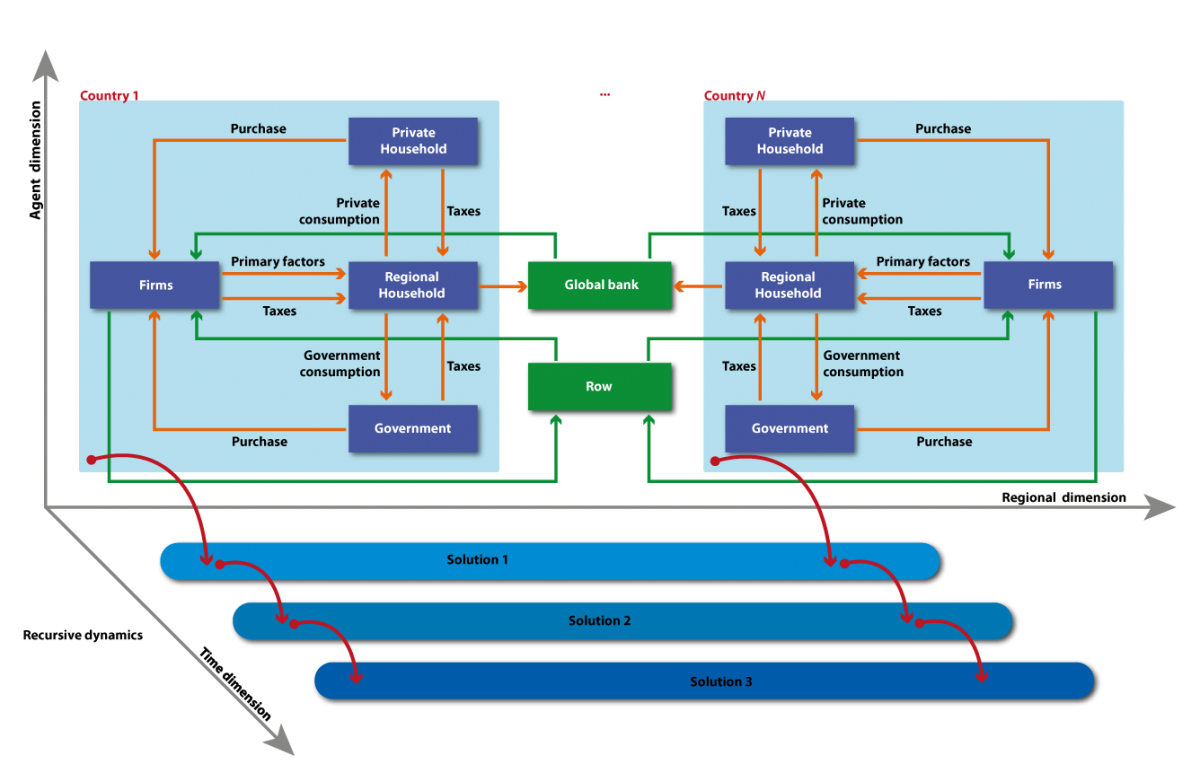
The model is flexible in regional aggregation and time horizon up to 2050. The Figure below summarises the interaction of regions or countries through economic flows within a country as well as with the rest of the world (Row). In each optimization step, the model gives a snapshot of domestic economic flows among actors (firm, private household, government) in each region and international trade with the rest of the world.
On April 12, 2026, the Center for Global Sustainability at the University of Maryland, Peking University and Tsinghua University celebrated the release of GCAM-China-v8. This update introduces a series of new features, including harmonization with the latest global GCAM v8.2 framework, updating the base year to 2021, introducing a provincial-level
We are pleased to share several recent developments and resources that may be of interest to the community: Preprint on New SSP OperationalizationA preprint article has been released introducing a new operationalization of the Shared Socioeconomic Pathways (SSPs) for 188 countries through 2150. This work covers a wide range of
Bc3 is pleased to announce the release of the first version of GCAM-Europe, an expansion of the well-established GCAM model. The model is fully accessible via our GitHub repository: https://github.com/bc3LC-GCAMEurope