Beta
This website is in development — content and design are still changing
Model
REMES
REMES is a Computable General Equilibrium model that represents the Norwegian economy with a particular focus on the energy system. REMES is used to study the effects of macroeconomic policies on the Norwegian economy. The model splits the national economy into five regions, which coincide with the five Norwegian energy
REMES is a Computable General Equilibrium model that represents the Norwegian economy with a particular focus on the energy system. REMES is used to study the effects of macroeconomic policies on the Norwegian economy.
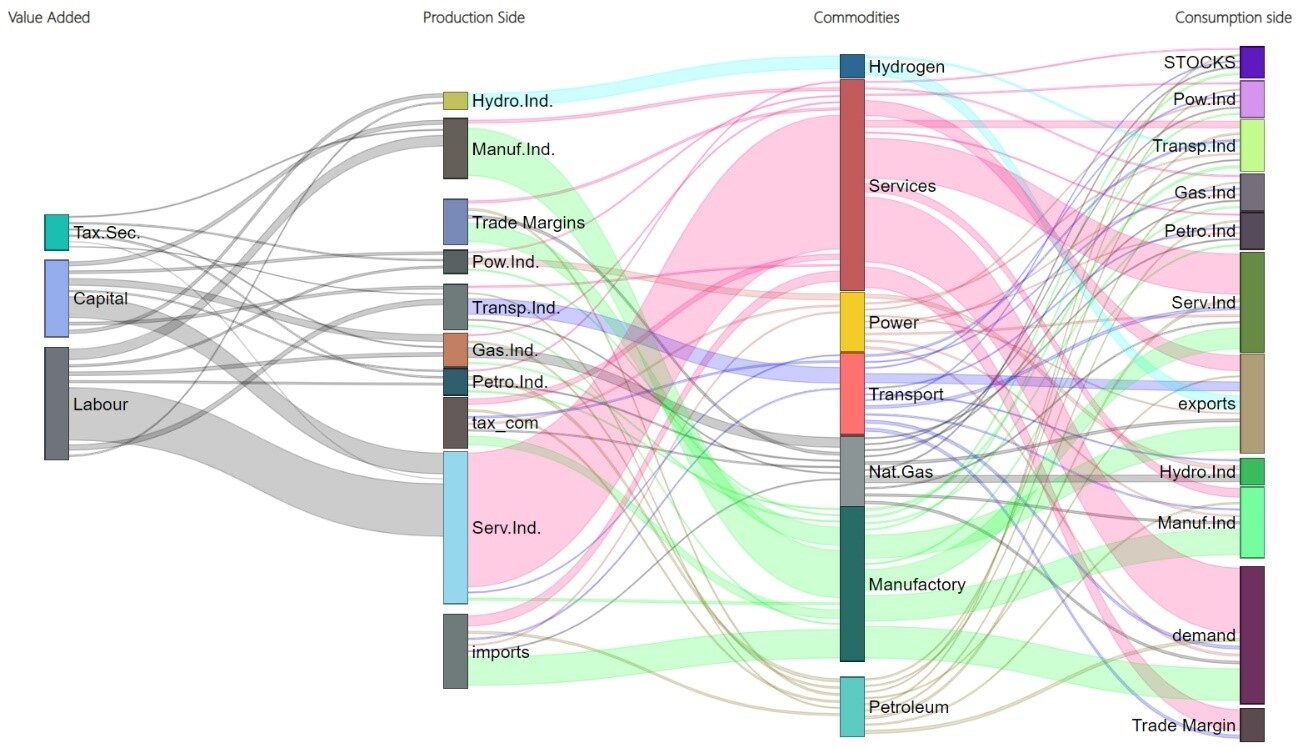
The model splits the national economy into five regions, which coincide with the five Norwegian energy market zonal prices. It includes 36 production sectors and 32 products and considers demand from households, investors and government alongside international imports and exports. . Policies are modeled as shocks, which influence the economy by means of taxes or subsidies. Effects are considered on prices, activity levels exports, imports and technology changes. The structural interconnections between the main building blocks in the model are displayed in Figure 1, where the arrows illustrate the payments direction between the elements of the model.
On April 12, 2026, the Center for Global Sustainability at the University of Maryland, Peking University and Tsinghua University celebrated the release of GCAM-China-v8. This update introduces a series of new features, including harmonization with the latest global GCAM v8.2 framework, updating the base year to 2021, introducing a provincial-level
We are pleased to share several recent developments and resources that may be of interest to the community: Preprint on New SSP OperationalizationA preprint article has been released introducing a new operationalization of the Shared Socioeconomic Pathways (SSPs) for 188 countries through 2150. This work covers a wide range of
Bc3 is pleased to announce the release of the first version of GCAM-Europe, an expansion of the well-established GCAM model. The model is fully accessible via our GitHub repository: https://github.com/bc3LC-GCAMEurope