Beta
This website is in development — content and design are still changing
Publication
WMO Global Annual to Decadal Climate Update for 2021–2025
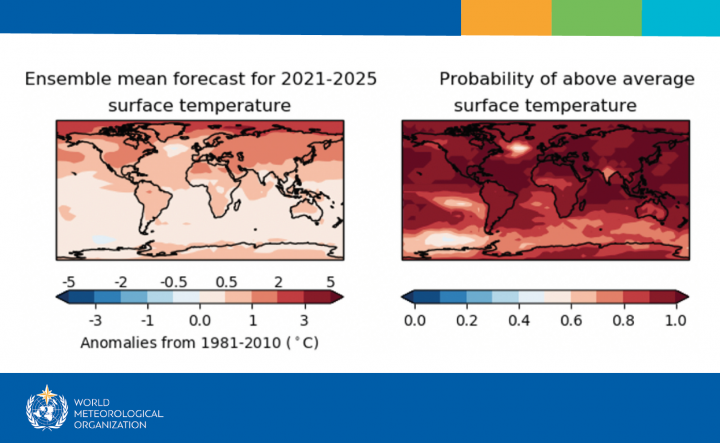
The World Metereological Organization (WMO) Lead Centre for Annual-to-Decadal Climate Prediction collects and provides hindcasts, forecasts and verification data from a number of contributing centres worldwide. The Global Annual to Decadal Climate Update for the period 2021-2025 has been recently released. Predictions of climate indices and global fields are obtained
The World Metereological Organization (WMO) Lead Centre for Annual-to-Decadal Climate Prediction collects and provides hindcasts, forecasts and verification data from a number of contributing centres worldwide. The Global Annual to Decadal Climate Update for the period 2021-2025 has been recently released. Predictions of climate indices and global fields are obtained from multi-model initialised decadal climate predictions that are started at the end of 2020 and contribute to the WMO Lead Centre for Annual to Decadal Climate Prediction.
In a nutshell, the update predicts that annual mean global (land and sea) mean near-surface temperature is likely to be at least 1°C warmer than pre-industrial levels (defined as the average over the years 1850-1900) in each of the coming 5 years and is very likely to be within the range 0.9 – 1.8°C. The reporst suggests that it is about as likely as not (40% chance) that at least one of the next 5 years will be 1.5°C warmer than pre-industrial levels and the chance is increasing with time. In addition, over 2021-2025, almost all regions, except parts of the southern oceans and the North Atlantic are likely to be warmer than the recent past (defined as the 1981-2010 average).
The transition to a low-carbon economy is expected to increase material requirements, as low-carbon technologies (LCTs) typically require more materials than fossil fuel-based energy systems. Here, we extend the MEDEAS-Spain Integrated Assessment Model (IAM) to improve the representation of material requirements, stocks, and flows. Key novelties are: (i) the use
This study uses advanced machine learning algorithms to analyze the indicators influencing national climate ambition in 2030 emissions targets and net-zero pledges. By focusing on technical and social feasibility, and political credibility, we assess climate ambition of countries through cumulative per capita emissions from 2021 to the net-zero target year.
Foundation models for Earth systems have so far been trained primarily on physical climate and weather data, with limited representation of the human systems that both drive and respond to environmental change. The lack of a unified global training resource that combines climate, land, ocean, cryosphere, infrastructure, hazards, and socioeconomic